
Two aircraft carriers would cement UK’s position as global player
Posted on July 23, 2013 at 5:04 pm
RUSI News, 9 Sep 2013
A decision to adopt just a single UK aircraft carrier would provide poor value for money and compromise the government’s ability to answer international crises, argues a brand new report published by the Royal United Services Institute (RUSI).
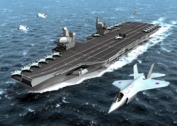 Leveraging UK Carrier Capability, written by Tobias Ellwood MP, argues that a choice to function both the aircraft carriers currently being built would cement Britain’s position as ‘a global player with an army power of the primary rank’ and in addition provide compelling operational and monetary benefits. ‘The UK either needs a carrier capability or it doesn’t. If it does, then at least two are required so that it will have one permanently available.’
Ellwood writes that there ‘is a narrowing window of opportunity you obtain equipment, develop protocol and train personnel with a purpose to maximise the early potential of this unique class of carrier.’ Chief a number of the final decisions to be remodeled the carriers is whether or not both will enter service or simply one.
The 2010 Strategic Defence and Security Review proposed holding a second carrier in ‘extended readiness’ as one choice to reduce costs. However the paper argues that a ‘£3-billion carrier waiting in “suspended animation”… has political consequences, as does the marketing of a boat at a loss. Neither option is wise use of taxpayers’ money.’
The paper, launched at the first day of the RUSI Maritime conference, points out that during the UK’s 2011 Libya campaign, a scarcity of carrier strike capability meant that RAF Tornados and Typhoons needed to fly a 4,830km round trip from the united kingdom to North Africa until logistics were in place at Gioia del Colle, Italy. ‘Although this base was much towards the targets, Tornados still required two mid-air refuelling operations with a purpose to complete their missions.’ The expense of using foreign bases, in-air refuelling, extended flying time and air-frame fatigue add as much as ‘the cost of land-based air costs (at a distance of 600 miles) rising to four times that of carrier-based operations’.
Ellwood argues that the ‘The carrier’s agility and independence means it’s prone to be one of several first assets deployed to any hotspot world wide.’ He adds, ‘The UK carrier capability is a transparent statement of “conventional deterrence”, complementing the united kingdom strategic deterrent as its ultimate security guarantee.’
But the significance of those ships for Britain’s foreign policy is at odds with the restrictions of operating just a single hull. ‘A single carrier will be limited in both availability (to around 200 days each year) and role. As both carrier strike and littoral manoeuvre require regular embarked periods to validate and maintain role-specific currency, a single ship can be in perpetual re-role.’ Operating just one carrier would mean significant gaps in service, as ‘every eight to 5 years a single ship will be faraway from the schedule as a result of routine (but extended) maintenance.’
‘To date there was little agreement,’ writes Ellwood, ‘as to how the costliest defence project ever (carrier and aircraft combined) might be utilised.’ ‘With a lead time of eight years, appreciating the complete contribution the carriers can offer would be certain that they commence operations as state-of-the-art assets with the built-in agility to evolve quickly at some point as opposed to date before their time.’
To read the occasional paper Leveraging UK Carrier Capability: A Study into the Preparation for and Use of the Queen Elizabeth-Class Carriers in full, click here.
NOTES FOR EDITORS
1. Leveraging UK Carrier Capability was released at the first day of RUSI’s annual Future Maritime Operations conference. For more at the conference, please visit www.rusi.org/maritimeconference/
2. RUSI is an independent think-tank for defence and security. RUSI is a singular institution; founded in 1831 by the Duke of Wellington, it embodies nearly two centuries of forward thinking, free discussion and careful reflection on defence and security matters.
ENDS
Further Analysis: , , ,

Posted in Security Systems