
From Interim to Final Status: Iran, the E3+3, and the street from Geneva
Posted on July 1, 2013 at 7:58 pm
RUSI Analysis, 6 Dec 2013 By Shashank Joshi, Research Fellow
Iran’s nuclear programme was temporarily capped. However the details of the endgame remain shrouded in uncertainty. How can we get from here to there?
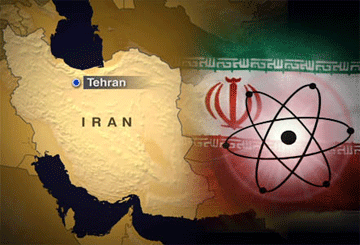
In a prior piece of research, I examined the content of, and reaction to, the historic Geneva agreement agreed between Iran and the E3+3 (Britain, France, Germany plus the usa, Russia, and China) on 24 November. But where will we go from here?
One of Israel’s greatest – if mistaken – fears concerning the agreement with Iran is this short-term deal will harden right into a long-term one, legitimating an oversized Iranian nuclear programme. The agreement to curb Iran’s nuclear program is worded carefully to preclude this: although its six-month duration is renewable, it also commits both parties ‘to conclude negotiating and commence implementing’ a last deal within a year’. But bridging the distance between the interim period and an extended-term settlement will prove exceptionally difficult.
An Endgame in Three Acts
Three phases of the agreement
For something, the endgame is clearer than it was – but still opaque. To grasp this, we must always divide the agreement into three phases.
First comes the six-month period of the interim deal itself. Next week, experts from the E3+3 will meet with Iranian counterparts to finalise the deal’s implementation, and therefore when this six-month period is to start. Iranian officials have said it’ll begin in January. This era is ‘renewable by mutual consent’, though, as I discuss below, this will surely precipitate a brand new push for brand spanking new sanctions and would clash with the commitment to succeed in a last deal within a year.
Second is the ‘comprehensive agreement’. In this period, Iran is granted ‘a mutually defined enrichment programme with practical limits and transparency measures’, and all sanctions are lifted. It will be important to notice that this isn’t, technically, a last status since it is to last only ‘for a period to be agreed upon’. This can be a concession from Iran, which desired to fix precisely how long it’d be bound by these limits. Jofi Joseph, until recently the NSC’s top Iran official and participant in talks with Iran, has suggested that Western powers might push for something ‘on the order of twenty or maybe thirty years’, partly at the basis that Iran could be more likely to have evolved in a more positive political direction over any such long period. Other analysts from E3+3 member states have suggested more modest periods of only some years. But what’s clear is that while the Geneva agreement calls this the ‘final step’, it’s actually more like parole.
This defined period could also be defined temporally, nevertheless it can even likely be associated with a so-called ‘broader conclusion’ from the IAEA that no military nuclear activities are continuing within Iran. But once the sort of conditions are met and this era concludes, the Geneva agreement is obvious that ‘the Iranian nuclear program may be treated within the same manner as that of any non-nuclear weapon state party to the NPT’. This suggests that the ‘practical limits’ of the excellent agreement will disappear. Iran would be free to change or develop its nuclear programme because it wishes, in the terms of its obligations under the Nuclear Non-Proliferation Treaty (NPT).
From interim period to comprehensive agreement
Negotiating the second one of those phases, the great agreement, is the hard part. Iran have been granted a conditional right to complement, however much the united states insists otherwise and Iran spins that it’s ‘inalienable’. It gets to complement within ‘mutually agreed parameters according to practical needs, with agreed limits on scope and level of enrichment activities, capacity, where it’s performed, and stocks of enriched uranium, for a period to be agreed upon’. That’s a creative compromise that permits either side to return away claiming victory. But those ‘parameters’ may be hotly debated.
Take ‘practical needs’, working example. Iran has before claimed it might build 10-20 nuclear power stations. Indeed, just because the Geneva agreement was being finalized, the Atomic Energy Organization of Iran (AEOI) announced that it was now considering the second one and third of those (after the Russian-built Bushehr). In a November 2013 interview with the Financial Times, Iranian President Hassan Rouhani declared, ‘how much we can expand enrichment or … how big the dimensions goes to be is dependent upon our needs for nuclear fuel’. Western powers are unlikely to simply accept either the enrichment capacity or enriched uranium stockpile commensurate with any such programme – it might involve a variety of Iran’s present enrichment – and may instead ask that Iran import its fuel, because it does for Bushehr.
How much enrichment is simply too much? Iran presently has over 19,000 centrifuges installed and over 10,000kg of uranium enriched to under 5%, with which it may ‘break out’ – produced sufficient High Enriched Uranium (HEU) for one bomb – in around two months. Western powers would need that point to elongate to a year, a minimum of. As Scott Kemp has explained in graph form, that might mean both centrifuge numbers and the enriched uranium stockpile must fall to a fragment in their present levels: one option can be 2,000 IR-1 centrifuges and 800kg of enriched uranium, roughly what Iran possessed before 2008, or even fewer centrifuges if any were to be more efficient second-generation variants.
The Arms Control Association’s Darryl Kimball has proposed ‘no greater than 3,000-4,000 centrifuges’. The Financial Times cites Western officials as claiming that Israel is pushing for ‘between 1,000 and a couple of,000’. These figures will be compatible with quite a lot of breakout times counting on how much enriched uranium Iran retained; it makes little sense to consider centrifuges alone.
For individuals who wanted Iranian enrichment to forestall altogether – including Israel, and plenty within the US Congress – this can be as unacceptably large a programme because it could be unacceptably small for Iranian hardliners. Iranian officials have frequently emphasised that their priority is at the principle of enrichment in preference to the extent and amount, and this long-held point of emphasis will constrain their rhetorical and bargaining options over the following six months. In practice, most foreign suppliers of civil nuclear technology would even be wary of signing contracts with Iran that didn’t include strict provisions on how fuel was handled – and therefore Iran’s energy needs are presently zero. Iran might conform to maintain a small fuel-manufacturing programme as an insurance plans against disruption of foreign supplies, whilst accepting that almost all of its fuel will be imported. However the psychology of loss aversion makes it harder to just accept large reversals in enrichment capability. For Iranians, the reference point for the nuclear program is 2013; for the E3+3, it would be 2002, when Iran’s enrichment programme was in its nascent stages. Bridging this gap often is the most time consuming aspect of the subsequent six months’ diplomacy.
After the excellent agreement
Once the great agreement expires – whether it lasts for years or decades – there might then be further haggling. The agreement says Iran ‘will be treated inside the same manner as that of any non-nuclear weapon state party to the NPT’. Iran is bound to argue that this suggests the removal of all limits, whereas Western powers could mention that many NPT members voluntarily accept restrictions on their programs, and that Iran should accomplish that too. Much would depend, here, on how Iran’s political system had evolved in the meanwhile period. If Iran had progressed in a more democratic direction and was on better terms with the arena and its neighbours, Western concern would diminish greatly.
In addition to the deeply-buried Fordow enrichment plant, the long-term status of Iran’s heavy water reactor at Arak may be especially problematic. Iran will claim that its decision to forego reprocessing (essential to separate plutonium from spent fuel) is a sufficient safeguard. Additionally, as Jofi Joseph notes, ‘Iran may argue that its continued operation during a CBM [interim] phase establishes a precedent for its permanent acceptance’; indeed, that Arak safeguards are even mentioned within the Geneva agreement is probably seen to imply that activation will occur sooner or later. However the West will want Iran to dismantle the entirety or – something alluded to within the Geneva agreement – convert it right into a more proliferation resistant light water reactor (something that some experts caution would mean dismantling the entire thing and building a brand new facility).
But if and when the IAEA declares with confidence that there are not any military nuclear activities occurring in Iran, imposing these limits may prove impossible. However Iran did convert Arak right into a light water reactor, then it can theoretically have the precise to construct a heavy water reactor when these limits expired. This isn’t going to sit down well with some inside the E3+3, like France, who raised a storm at the issue of Arak inside the first round of Geneva talks earlier this month, but others, like Russia, might see significant commercial opportunities in giving Iran more latitude.
Ultimately, Iran is not going to accept any agreement where it’s treated as an unequal member of the NPT. It’s because the Geneva agreement sensibly includes the promise of in depth ‘international civil nuclear cooperation’, which might incentivise Iran to restrict its nuclear programme voluntarily even after a comprehensive deal expires. To the level that a democratic Iran on better terms with the area would be viewed in less threatening terms, non-nuclear rapprochement – however distant it’s now – would also reinforce confidence in Iran after limits expired.
Domestic Politics
Iranian politics
Finally, despite the fact that the 2 sides could find common ground on a last status, either side would face domestic political obstacles to a deal. Up to now, Iranian hardliners have largely withheld their reservations, perhaps end result of the imprimatur given to the agreement by the Supreme Leader. But there may be disagreement within Iran’s parliament, the Majlis, around its authority over an enduring accord. The spokesperson for Majlis’ presiding board has argued that what’s confirmed by the Supreme Leader doesn’t should be confirmed by parliament, but others have protested this judgment and stated that Article 77 of Iran’s constitution requires parliamentary approval (all links in Persian).
At the very least, the Majlis would need to ratify Iran’s Additional Protocol, an agreement between Iran and the IAEA that enables intrusive inspections that the Khatami government signed in 2003 but later disavowed. Moreover, the interim agreement specifies that only ‘nuclear-related’ sanctions might be lifted within the comprehensive agreement: although these impose the best economic cost on Iran, many Iranian legislators won’t have realised that numerous non-nuclear sanctions, referring to terrorism and human rights, will remain in place.
American politics
On any other side, america Congress has expressed bipartisan scepticism towards the interim deal, and plenty of legislators appear to think, mistakenly, that it’s going to or will result in the dismantlement of Iran’s nuclear program. Because the agreement is arguably this administration’s most vital foreign policy achievement so far, and that new sanctions would explicitly violate its terms, President Obama is definite to veto any sanctions bill that Congress passes.
A presidential veto over a foreign policy subject will require a two-thirds veto in both the home and the Senate (for international readers: lower and upper houses of the united states legislative branch, respectively), but this has not happened since Congress’ overturning of sanctions imposed by President Reagan in 1986 over apartheid in South Africa – today, Obama will require just thirty-four senators to stay loyal.
But if a sanctions bill provides for conditional sanctions triggered after the six month interim period is up – as Senate Foreign Relations Committee chairman Robert Menendez has proposed – then a veto might meet with greater bipartisan resistance. Any attempt by the E3+3 or Iran to resume this agreement can be seen in Congress as a troubling sign that the united states and Iran were colluding to show this right into a permanent agreement, despite the US’ protestations on the contrary. As Michael Krepon notes, the lesson from Cold War arms control is that follow-on accords ought to be negotiated as quickly as possible to bypass spoilers disrupting the method.
More importantly, considering current sanctions involve not only 16 executive orders but in addition nine congressional acts, a comprehensive agreement might require that Congress pass new legislation, which in turn will require that they consent to whatever compromise Iran and the E3+3 arrive at at the list of remarkable issues discussed earlier. Presidential authority to waive sanctions can be utilized within the first stages of a comprehensive agreement, but eventually Iran would have to see irreversible steps being taken. Meanwhile, quite a few legislators are going to take issue with the undeniable fact that issues like Iran’s missile programme have gone unaddressed, and should seek to impose unrealistic conditions onto the E3+3 that transcend the terms of the roadmap agreed this weekend.
The interim agreement has put Iran farther from a nuclear weapon, demonstrated that america and Iran are able to holding sustained and effective high-level talks, untied one of the most greatest knots within the dispute – Iran’s claimed right to enhance – and established an ambitious timeline for resolving the dispute as a complete. It’s a chic diplomatic fix. But the majority of the important points are yet to be filled in, or even then the political hurdles to a last deal are daunting.
This text is customized from an earlier article at Foreign Policy’s Middle East channel.
Further Analysis: , , ,

Posted in Security Systems