
Syrian Chemical Weapon Disposal: Confronting the Challenges
Posted on June 25, 2013 at 3:43 pm
RUSI Analysis, 3 Oct 2013
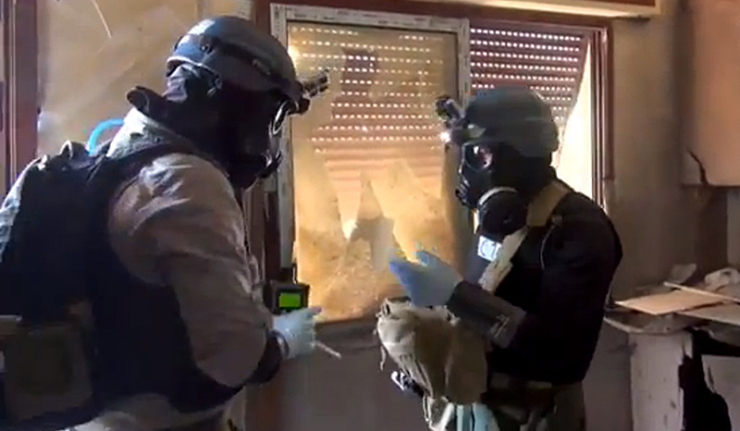
This week, a UN inspection team begins the onerous task of monitoring and dismantling Syria’s chemical weapons stock. A former UN weapons inspector charged with the destruction of Iraq’s stockpiles highlights the challenges ahead.
By Garth Whitty
The Iraq Inspection Regime
In January 1992, the planning for the destruction of Iraq’s chemical weapons stockpile, bulk chemical warfare [CW] agent, CW agent precursor chemicals and associated infrastructure, including dual use facilities was commenced at UN Headquarters in Manhattan.
A cardboard box contained numerous uncatalogued photographs of weapons and facilities and despite inspection missions having made a variety of trips to CW sites in Iraq, there has been a dearth of information available. This was partly a consequence of the absence of a coherent filing system and partly because information garnered on UN inspection missions instead of being deposited and shared were taken back to inspector countries of origin. The UN Special Commission (UNSCOM) staff included UN staffers and individuals seconded by contributing nations a number of whom were fully committed to the UN objective while others were in place to collect intelligence for his or her nations or to forestall disclosure of the sources of the chemicals, equipment and expertise that had allowed Iraq to acquire a considerable CW capability.
The following month, the 1st Chemical Destruction Group [CDG] mission to Iraq occurred and despite pre-mobilisation warnings on the contrary, and participant expectations, they didn’t encounter hostility from the Iraqi people nor the extent of obstruction from Iraqi government officials that may were reasonably anticipated.
Then and inside the following months, the operational security environment for those engaged within the work of the CDG was overwhelmingly benign. It’s true that cruise missile strikes in Baghdad, based on failure of the incumbent Ba’athist regime to handover documents or facilitate inspection missions, led to orchestrated ‘popular’ protests against the UN and minor hindrances. However the CDG was largely unimpeded in its ability to continue with its mission.
Early CDG missions into Iraq included the recovery and field destruction of 122mm rockets that were in such poor condition that many were ‘weeping’ their sarin nerve agent payload. Despite the risk inherent in working with potentially lethal items that during addition to the CW agent included unstable high explosive and rocket fuel, strict operating protocols ensured the protection of the CDG; the greater health hazard being posed by working in temperatures of as much as 55 degrees centigrade while wearing protective respirators and chemical suits.
A visit to the 25 square kilometre Al Muthanna State Establishment for Pesticide Production near town of Samarra – which included production facilities, laboratories, bomb damaged storage bunkers and their chemical weapons content, and CW inventory recovered from other sites – signalled the requirement for an in-country based CDG presence until the duty was completed. While the CDG was taken with chemical weapon destruction, other UNSCOM missions continued to search out further undeclared weapons, facilities and knowledge.
The core elements in attaining success were diplomacy, operating environment and technical ability. Iraq have been defeated militarily, the realm powers stood together of their insistence that every one weapons of mass destruction should be put beyond use; and from the start, Iraqi personnel assigned to the destruction programme accepted the idea that the earlier the destruction of the chemical weapons stockpile was completed, the earlier the CDG and subsequently other UNSCOM personnel would depart.
The security environment was largely benign although the degree of comfort or discomfort experienced by team members was variable and depending on the extent of previous exposure to a potentially hostile or hostile environment. Although this was the primary time this type of programme were undertaken anywhere on this planet, where none of the team participants had previously been subjected to such high levels of CW contamination and potential health threatening exposure, there has been a wealth of experience and great confidence within the equipment and fellow team members in ensuring individual and collective safety.
Challenges for Syria
Syria though seriously is not Iraq and there were significant CW protection, detection and destruction technology advances during the last 20 years, which includes the formation of an organisation devoted to the overseeing of a chemical weapons free world, the Organisation for the Prohibition of Chemical Weapons. However, the Syrian diplomatic and security environments are vastly more complex than those experienced in Iraq. The time-frame for placing all Syrian chemical weapons beyond use can also be significantly truncated when compared with the work of UNSCOM and the successor UNMOVIC (UN Monitoring and Verification Commission) with the work of the Chemical Destruction Group being completed in 1994 however the seek unaccounted items continuing until 2002.
The scale and origin of the Syrian chemical weapons programme is unclear, but it is cheap to imagine similarities with the Iraqi programme. This could suggest the embracing of chemical weapons by the Syrian Ba’athist government as ‘the poor man’s nuclear bomb’ within the 1970’s with raw materials, equipment and expertise coming from both the Soviet Union and the ‘free world’.
Agents are inclined to include those who attack the nervous system, sarin, VX and tabun, the lethality of in an effort to have reduced in the event that they were stored for long periods, and high grade mustard blister agent with a complete volume of 1000 tonnes having been suggested. chemical weapons precursors including those which can be dual use, folks that will also be used for non-weaponisation purposes, will add to the dimensions of the inventory. The carriers for the weaponised agent usually are predominantly 122mm rockets and 155mm artillery shells and small numbers of Scud missiles.
It isn’t a considering the fact that when the OPCW goes to the UN Security Council they’ll receive the unanimous support essential to undertake their mission as they might wish and compromise might be dictated. Furthermore, the subtle health and safety regimes developed in the OPCW and externally because the Iraq destruction programme are inclined to shape operational delivery. The liberty of movement enjoyed by UNSCOM and UNMOVIC inspectors seriously is not repeated, and it isn’t clear what leverage the present inspection regime can have. In Iraq the specter of actual military strikes were the final coercion, but this would not be mandated in terms of Syria.
Although peace negotiation overtures were made, it’s unlikely that peace may have been achieved in the agreed chemical weapons destruction time-frame. After all a peace agreement between the Syrian government and the intense elements of the opposition coalition seems unlikely under any circumstances. It could require the securing of chemical weapons sites or transportation to and concentration at one site under combat conditions.
Logistical Challenge
To do so would necessitate the commitment of a considerable military force, full co-operation of the Syrian government in declaring all sites and inventory; and pose significant logistic challenges. Cross referencing the Syrian government’s declared inventory with what other countries believe Syria possesses can be complicated and time consuming. Mission success can also be eluded if there’s a mismatch between both, or if the Syrians have destroyed weapons on their lonesome initiative, handed them over to sympathetic countries or groups akin to Hizbollah as have been suggested. . It really is probable that are meant to a ‘guard force’ be agreed, nations aren’t queuing to contribute and of these who did some will be blocked by the signatories for political reasons.
In the development these challenges are overcome, the chemical weapons would need to be destroyed on-site at storage facilities, at a central concentration site to which all CW have been transported outside Syria. The latter option, while potentially the quickest way of denying further use of chemical weapons, would even be one of the most complex commencing with identifying a recipient country acceptable to the parties and willing to receive weapons of mass destruction. In 1992 it took six months to design, build and commission a destruction furnace and a caustic hydrolysis facility. And while there at the moment are portable plant chemical weapons destruction units available, it truly is likely that there’ll be a major delay from the passing of the resolution to commencement of destruction.
The technical elements of the destruction process are a sequence of heterosexual forward steps requiring location, securing, identification, accounting, rendering safe, transportation, disassembly and final disposal. All this while safeguarding the personnel involved, the local population, the national livestock herd and the broader environment.
The diplomatic and security challenges are far greater and undoubtedly there’ll be obstruction, obfuscation, difficulty in attaining the required staffing levels, an absence of consensus. Moreover, though we’d all wish otherwise, there’s the strong possibility that it can be a ‘mission impossible’ after which a return to the UN Security Council would be called for, with the opportunity of the sanctioning of air strikes which set off collateral damage including the discharge of chemical warfare agent into the ambience with a deleterious impact at the health of individuals whether pro or anti-Syrian government.
It can be in the bounds of credibility, in a rustic that has witnessed the overrunning of presidency facilities and members of the govt. forces changing their allegiance in favour of opposition groups (because the Syrian government claims), that the opposition do indeed now hold chemical weapons inventory beyond the reach of inspection and destruction teams. Meanwhile Islamic Jihadists and Christian fundamentalists prepare for Armageddon which consistent with their respective prophesises is centred on Damascus.
In 1992 Garth Whitty, a British Army Bomb Disposal Officer with extensive experience of chemical weapons disposal, was seconded to the UN Special Commission to Iraq and tasked with the establishment of a world team charged with the destruction of Iraq’s chemical weapon stockpile and associated infrastructure. garthwhitty@yahoo.com
Further Analysis: , ,

Posted in Security Systems